Although out of order, I had to post a series of photos I took as a 200 foot tower cracked at the base and fell from Perito Moreno glacier. We were very lucky to have seen it!
Monday, April 12, 2010
Timber!!
Although out of order, I had to post a series of photos I took as a 200 foot tower cracked at the base and fell from Perito Moreno glacier. We were very lucky to have seen it!
Thursday, April 1, 2010
Goodbye Patagonia!
After one night in Punta Arenas where we dined on fresh king crab from the icy southern waters, our group said goodbye to one another and went our separate ways. It wasn't really a night since my flight back to Santiago was changed to leave at 4:15 a.m., meaning I was up at 2:30 a.m. While the airport in Santiago is highly functional, the domestic flights have been relegated to undesirable time slots, and are still operating out of tents on the tarmac, hence the ungodly departure time.
I was sad to be leaving so soon. Two weeks was not enough. Jenny was going on to Easter Island, which would have been a great addition, but given the state of the airport and flights, I thought I would make that destination another time.
Once in Santiago I had 12 hours to kill before my flight home (this takes me full circle back to my first blog post of the trip). Mountain Travel Sobek secured a day room at the Holiday Inn at the airport to rest for the day, which made things much easier as I was able to take a nap and go for a swim in their unheated pool, in addition to catching up on internet time. Good karma stayed with me, and I received a free upgrade to business class on LAN for my flight home. Sweet!
Thanks for being with me! I will be back around June 10, when I leave for Eastern Europe, specifically the Czech Republic, Slovenia and Croatia, with a launch point of central Germany.
Elizabeth
Above photo: Red fox outside of Torres del Paine smiles for the camera.
Wednesday, March 31, 2010
Puerto Natales, then Home
The last day of the trip (not including travel days)! Another long drive from Torres del Paine to Puerto Natales, then to Punta Arenas for the flight back to Santiago. Images flash.... In the bus, Juanito (the drive), TC (trip leader) and Sergio (local guide) are passing around the mate cup. Outside, a beret-wearing gaucho chases down and ropes an errant calf. Non-native alfalfa being bailed for a long winter. Granite spires and snow-covered peaks of the Patagonian ice-field.
We reached Puerto Natales mid-morning in time for a coffee and hot chocolate refreshment. The town reminds me much of Kodiak Island, Alaska; quiet and charming.
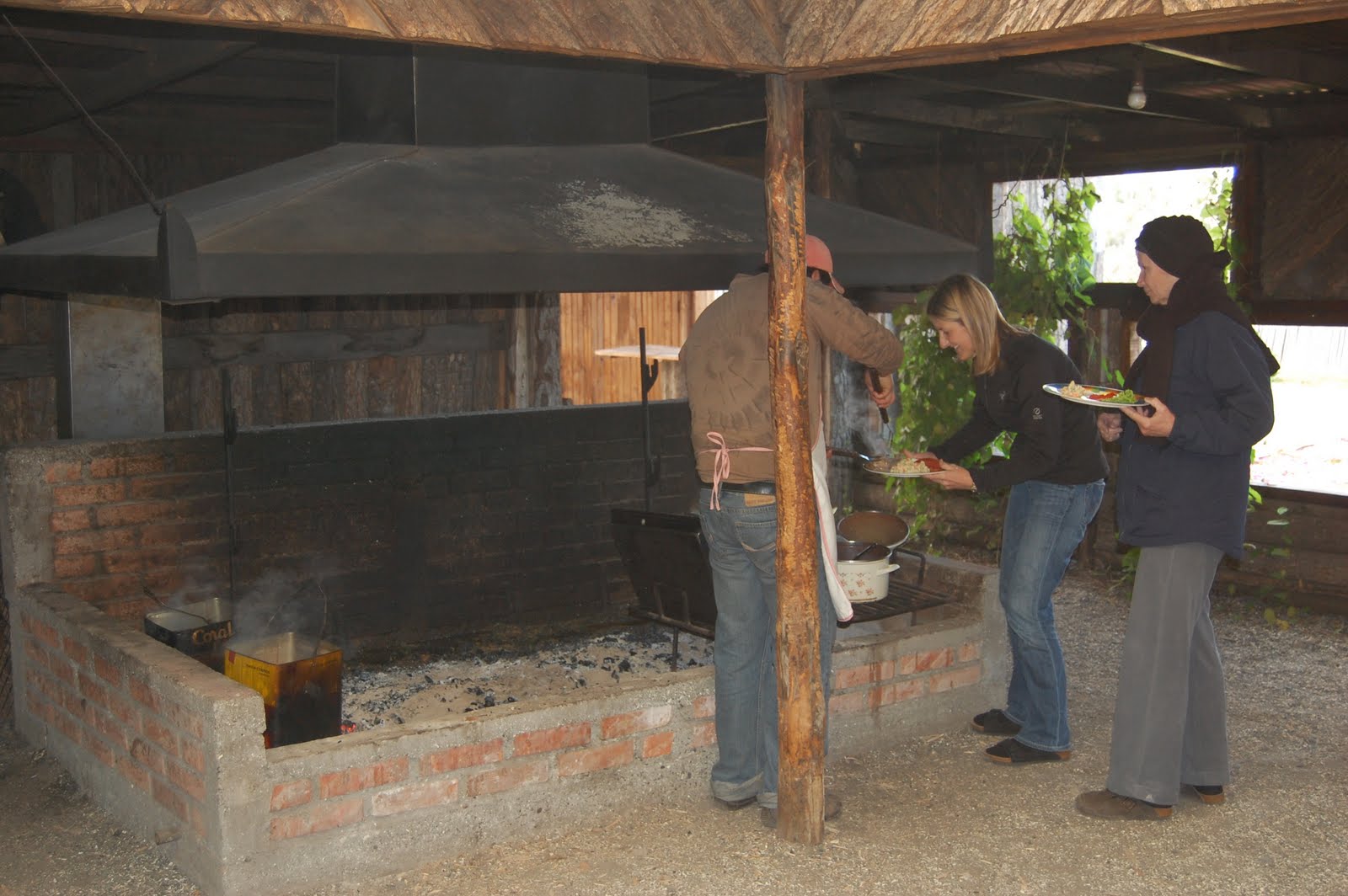
Almost to Punta Arenas, we stopped at an estancia for an asado (traditional barbeque). The food was fine, but I wasn't thrilled that the owner had turned his property into a kind of zoo to show tourists, keeping otherwise wild animals and birds in cages. They also gave us a sheep-shearing demonstration, which I could have done without. Watching a terrified sheep lose its coat has no appeal!
In Patagonia, ranchers have have been raising sheep for the last 100 years. Now, their big market is China. But sheep hooves are very damaging to the soil, making it harder for the wild animals to survive. In contrast, the native guanacos have soft padded feet that tread lightly...
Outside Puerto Natales for the first time I saw plastic bag pollution, with hundreds of plastic bags caught in stunted deciduous beech trees. Until then, I had seen not a one plastic bag littering the landscape. I noticed that no one gave plastic bags - even when I asked for one to cover a book I would be putting in my suitcase. Didn't have them. I asked about the pollution issue, but no one seemed to know. I think they realized a long time ago that wind and plastic bags don't mix.
Tuesday, March 30, 2010
Goodbye Torres del Paine
After such a brutal walk in the wind, we had the option the next day of easy hiking with the whole group, or a challenging 6-8 hour round trip jaunt up to the base of the spires of Paine (for which the park is named). Only Jenny and I chose the hard way.
Reflecting on the trials of the trip, we realized how lucky we had been with the weather in this unpredictable part of the world. We were never caught in real rain, or forced to change plans because of weather. While we wore our rain gear every day it was more for the wind than threat of rain. It seemed like a ray of sunshine was following us....
El Viento (The Wind)
We finally crossed into Chile for the last couple days of the trip at the National Park of Torres del Paine. Blustery rain pummeled the estancia where we were staying all night, but we awoke to bright sunshine... with howling winds. This was the day we would learn about the winds of Patagonia! Our group again split into 2 groups, and the same 3 of us braved it for a 5 hour hike through spectacular scenery, while the remainder were grounded lest they be blown away. I have never been in winds like this - the kind that literally blow you off your feet. We all stumbled, like we were drunk, down the narrow trail, but were rewarded by the views. We saw some clown-like Austral parakeets being blown about, but the wildlife was otherwise hunkered down, letting the wind pass.
Sunday, March 28, 2010
Patagonian Steppe
On the second day in El Chalten, 3 of us donned crampons and did a glacier hike, which gave us a whole different perspective on these massive ice fields. It wasn't raining, but it was COLD, maybe the coldest day so far (see photo below. Yes, I wore my Peruvian alpaca hat everyday. Not that cute, but very warm!) To get to the glacier, we took a boat across the glacial lake, and got up close and personal with some recently calved, very blue icebergs.

After El Chalten, we drove south again past El Calafate, back towards Chile. It was a long day over the brown Patagonian Steppe, but the advantage to being in a private vehicle is the ability to stop anytime to look at wildlife, birds, scenery or just to have coffee at a converted estancia.

We were all pretty interested in birds, so no one minded if we stopped for 20 minutes to photograph a rhea (flightless bird - see photo above) or an eagle. Also above: a herd of guanacos stops grazing to look at us. They are related to the llama.
After El Chalten, we drove south again past El Calafate, back towards Chile. It was a long day over the brown Patagonian Steppe, but the advantage to being in a private vehicle is the ability to stop anytime to look at wildlife, birds, scenery or just to have coffee at a converted estancia.
El Chalten & Mt. Fitzroy
Above: Sunrise on Mt. Fitzroy
Disaster. The afternoon that we arrived in El Chalten, base for exploring Mt. Fitzroy, I started to feel queasy. As I lay in my hotel room waiting for the inevitable, I summoned all my will to make the virus pass as quickly as possible, since our first hike of the trip was the following day. I also willed the weather to clear as it was pouring rain, combined with fierce winds - if it didn't clear, the hike wasn't going to happen. I drifted in and out of sleep for the next 14 hours, but woke in the morning feeling okay, able to eat a little, and happy to see clear skies! A total of 5 of 7 in our group caught the virus, but I only missed one dinner (whereas most people were out for 2 days), which I attribute to my very fast metabolism. Out out damn virus!
The hike split into 2 groups, with me, Jenny and one of the retirees taking the long route with the local guide. This turned into a marathon, 15 mile hike, up and down in the glacial valley below Fitzroy. Somehow I willed myself to finish, but wasn't feeling my strongest, to say the least!
Below: Sunrise over El Chalten. Sunrises in this part of the world are amazing!
Subscribe to:
Posts (Atom)